What Is High Relief? Definition, Examples and High Relief vs. Bas-Relief
High relief is sculpture whose forms project more than half their depth from the background, often with deep undercuts. Learn the definition, how it differs from bas-relief, famous examples and how to make one.
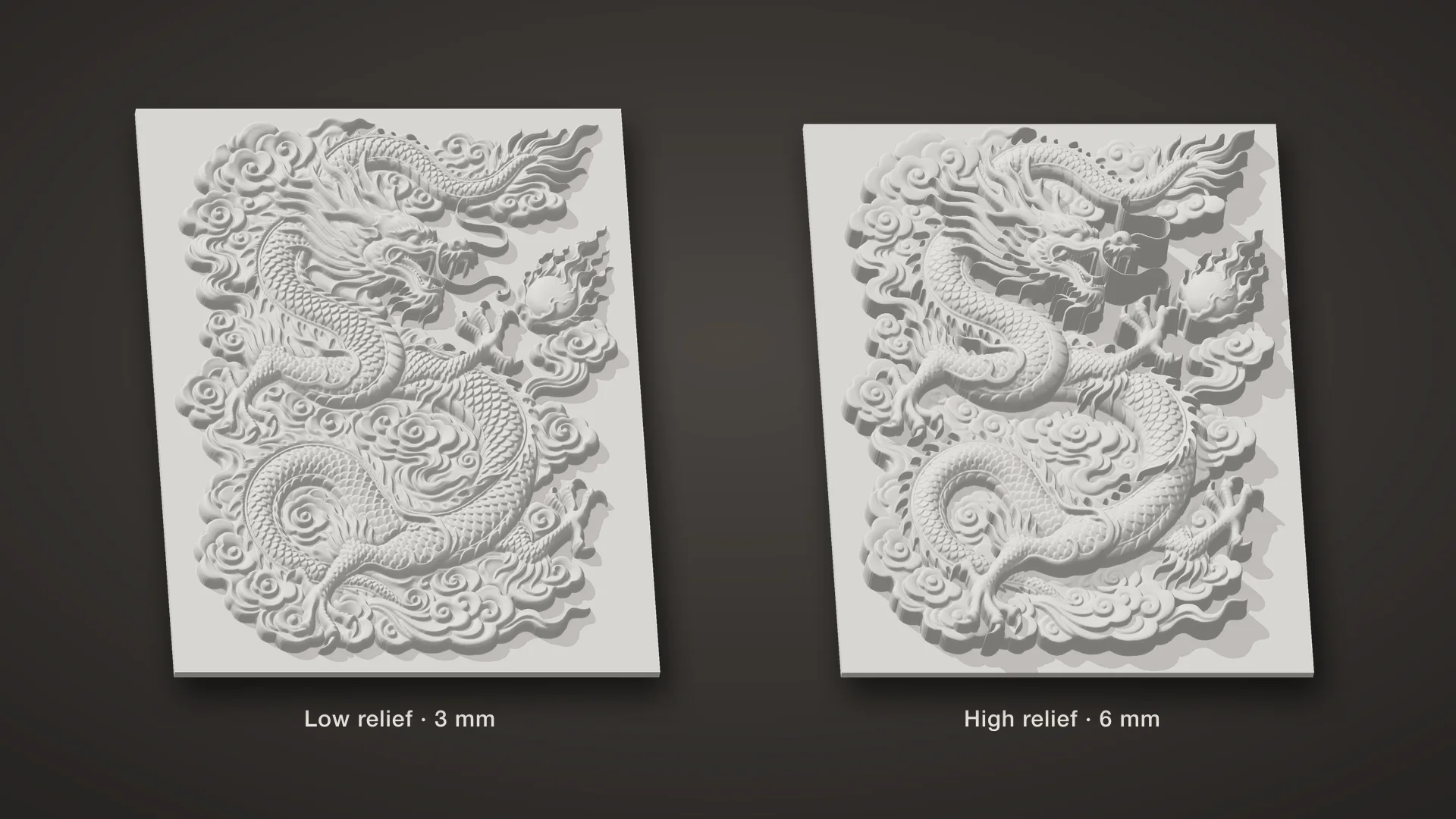
High relief is sculpture in which the figures stand out boldly from their background: more than half of each form projects, and arms, heads and legs are often cut free underneath so that only their backs stay attached. Where a bas-relief is a drawing given a few millimetres of depth, a high relief is a crowd of statues that has not quite stepped off the wall.
This guide covers what high relief means, how it differs from bas-relief and mid relief, the most famous high relief sculptures, how sculptors make them, and how to make a deep relief of your own — by hand, or from a photo with our image to relief generator.
High relief definition and meaning
The English term translates the Italian alto rilievo ("high relief"), and you will also see the French haut-relief. Both sit at the deep end of the relief family, opposite basso rilievo, the bas-relief.
Art historians define high relief by projection. In a bas-relief the forms rise less than half of their true depth from the background. In a high relief they rise more than half, and the most projecting parts — a head turned toward you, a raised shield, a horse's foreleg — may be carved almost completely in the round.
The other mark of high relief is undercutting. The sculptor cuts in behind the edges of the forms, so they cast deep, hard shadows and seem to float in front of the background. A bas-relief never does this: everything in it can be pulled out of a mould straight toward you. A high relief usually cannot.
High relief vs. bas-relief vs. mid relief
All three are reliefs: the sculpture stays attached to a background and is meant to be seen from the front. What changes is how far it leaves that background.
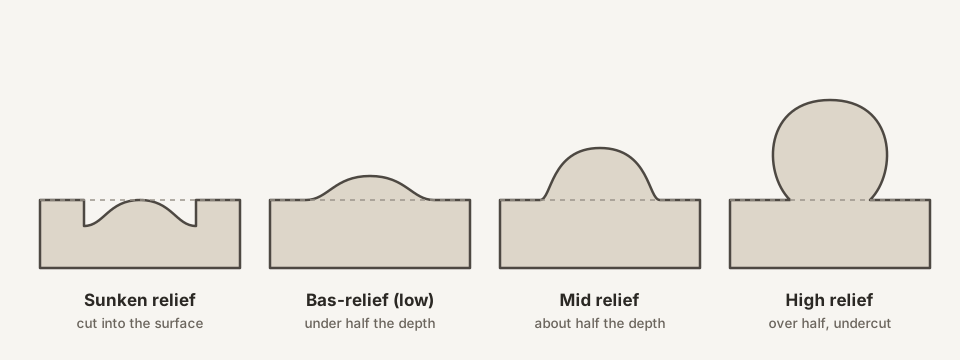
| Bas-relief (low relief) | Mid relief (mezzo-rilievo) | High relief (alto-rilievo) | |
|---|---|---|---|
| How far the forms project | Less than half their depth | About half | More than half, parts nearly in the round |
| Undercuts | None | Few | Many, often deep |
| Shadows | Soft; needs side light | Moderate | Strong under almost any light |
| Seen from the side | Nearly flat | Clearly raised | Figures stand well clear of the wall |
| Typical uses | Coins, medals, plaques, long friezes | Altarpieces, tombs | Temple metopes, monuments, church portals |
The boundaries are loose, and a single work often uses all three. Sculptors put the nearest figures in high relief and let those behind them sink into mid and low relief, so the depth of the carving itself suggests distance. Lorenzo Ghiberti's "Gates of Paradise" in Florence are the classic example: heads in the foreground almost leave the bronze, while the buildings behind are barely raised.
Famous high relief examples
High relief shows up wherever sculpture had to read from far away, in strong shadow, or with real drama.
- The Parthenon metopes, Athens. Ninety-two square panels carved in the 440s BC ran around the outside of the temple, high above the ground. The struggles of Lapiths and Centaurs on the south side are carved in such high relief that some figures are attached to the background only at the back. Many of them are now in the British Museum.
- The Pergamon Altar, Berlin. The Gigantomachy frieze, carved around 180–160 BC, shows the gods fighting the giants along more than 100 metres of marble. The figures burst out of the background, overlap the moulding and even spill onto the altar's steps.
- Michelangelo, Battle of the Centaurs (about 1492). Carved when Michelangelo was a teenager, this marble panel in the Casa Buonarroti in Florence is a tangle of bodies in deep relief. In the same museum hangs his Madonna of the Stairs, carved in the shallowest bas-relief: the pair show the two ends of the scale by the same hand.
- Late Gothic altarpieces. Veit Stoss's altarpiece in St Mary's Basilica in Kraków (1477–1489) and Tilman Riemenschneider's limewood altarpieces in Franconia fill their boxes with figures carved so deep that many are almost free-standing.
- Alessandro Algardi, Pope Leo I and Attila (1646–1653). This marble relief in St Peter's Basilica is more than eight metres tall. The foreground figures are carved almost fully in the round and seem to step toward the viewer.
- François Rude, Departure of the Volunteers of 1792 (1833–1836). Better known as La Marseillaise, this group on the Arc de Triomphe in Paris has the winged figure of Liberty shouting over soldiers who stand far out from the wall.
How high relief is made
High relief is made in the same materials as any sculpture, but its depth changes how each one is worked.
Stone
The carver works from a deep block and removes the background first, then cuts in behind the figures with chisels, rasps and drills. Ancient sculptors used running drills to open deep channels between limbs and folds of drapery, which is why so many Greek and Roman reliefs have dark, crisp shadows. Undercut stone is fragile, so projecting fingers, noses and weapons are usually the first parts to break off.
Wood
Limewood, walnut and oak can be undercut more freely than stone because they are stronger in thin sections. Many Gothic altarpieces are high relief built from several blocks: the figures are carved separately and then fixed to the back panel.
Bronze and terracotta
A cast relief is modelled first in clay or wax. Undercuts lock a simple mould onto the model, so high relief needs piece moulds that come apart in sections, or lost-wax casting, where the wax model is melted out. In fifteenth-century Florence Luca della Robbia made glazed terracotta reliefs in white and blue, many of them in high relief, that still look new today.
How to make a high relief
1. By hand
- Choose a block or a slab of clay deep enough for the boldest form. High relief needs several times the depth of a bas-relief of the same size.
- Set the depths before you detail anything. Decide what is nearest and what is furthest away, and block in those levels first.
- Keep the background figures in lower relief, so the nearest ones stand out.
- Undercut last, and only where a shadow helps. Every undercut makes the piece harder to cast and easier to break.
- Check the piece from the side as well as the front: a high relief is seen from more angles than a plaque.
2. From a photo
Our image to relief generator turns a photo into a relief in about a minute. In the tool, choose High relief before you generate: it uses a deeper carving model meant for 3D printing, while Low relief keeps the surface shallow for laser engraving and CNC routing. You can then set the carving depth yourself, in millimetres, and turn the model in the 3D preview to judge it. The picture at the top of this page is the same dragon photo made both ways, at the tool's default depths of 3 mm and 6 mm on a 60 mm plate: in high relief the dragon stands well clear of the clouds behind it.
One thing to know: a relief made from a photo is a height map, so every point of its surface has one height. That means it can be deep, but it cannot be undercut. The result is closer to a deep mid relief than to the Pergamon Altar, and that is often what you want: it prints face up without supports, mills on an ordinary three-axis CNC router, and lifts straight out of a mould. If you need true undercuts, use the generated model as a starting point and sculpt them in a 3D program.
A few tips for deep reliefs:
- Pick a subject that has real depth. A portrait bust, an animal or a figure with overlapping limbs gains from high relief; a flat logo does not.
- Give the plate enough thickness. A deeper relief needs a thicker base under it to stay flat and strong.
- Print it face up. For FDM printing, fine layers bring out the steep sides of a deep relief. Our relief to 3D guide lists layer heights, infill and print times.
Why choose high relief?
High relief is for work that has to hold its own: under flat light, from far away, or in a room full of other things. Bas-relief whispers, and needs a raking light to come alive. High relief throws its own shadows. That makes it the better choice for an outdoor memorial, a large wall piece or a portrait you want to read from across the room, while bas-relief suits coins, small plaques and anything that has to be thin, light or easy to cast.
Quick answers
Is high relief the same as alto-rilievo? Yes. Alto-rilievo is the Italian term and haut-relief the French; all three mean sculpture whose forms project more than half their depth.
What is the difference between high relief and bas-relief? How far the forms project and whether they are undercut. Bas-relief rises less than half its depth with no undercuts; high relief rises more than half and is often cut free underneath. Our bas-relief guide covers the shallow end.
Is high relief the same as sculpture in the round? No. A high relief is still attached to its background and is meant to be seen from the front, however deep it is. Sculpture in the round stands free and can be walked around.
Can a 3D printer make a high relief? Yes. A deep relief without undercuts prints face up with no supports at all. Undercut parts print too, but they need supports or have to be printed in pieces.