What Is a Bas-Relief? Definition, Meaning, Examples and How to Make One
A bas-relief is a sculpture that rises only slightly from a flat background. Learn the definition, how it differs from high relief, the classic materials, famous examples and how to make your own.
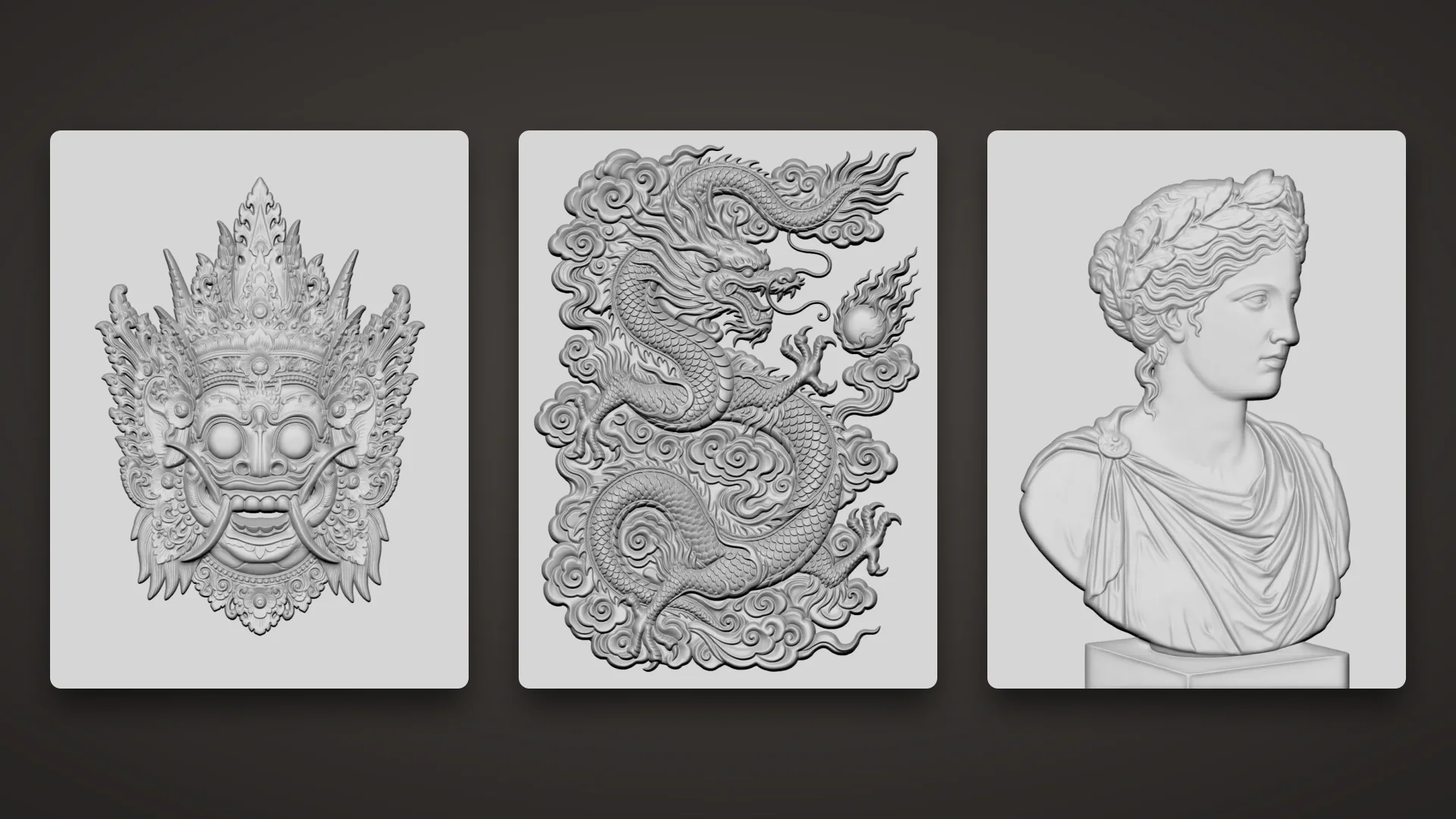
A bas-relief (pronounced "bah ruh-LEEF") is a sculpture in which the figures rise only slightly from a flat background. Nothing is undercut and nothing stands free: the image stays attached to its surface, like a drawing that has been given a few millimetres of depth. Look at the head on any coin in your pocket and you are looking at a bas-relief.
This guide covers the definition and meaning of the term, how bas-relief differs from high relief and sunken relief, the materials sculptors use, the most famous examples, and how to make one yourself — by hand, or from a photo with our image to relief generator.
Bas-relief definition and meaning
The term comes into English from French, which took it from the Italian basso rilievo: literally "low relief". Relief itself goes back to the Latin relevare, "to raise". So the bas-relief meaning is exactly what the words say: a raised image that stays low.
Art historians usually define a bas-relief sculpture by how far it projects. The forms stand out from the background by less than half of their true depth, and often by far less. A face that would be 20 cm deep in a statue might be compressed into 1 or 2 cm on a plaque. The sculptor does not simply flatten the subject like a pressed flower. The depth is compressed, while the outlines, the overlaps and the small changes of plane are kept, and those carry the illusion of a full, rounded form.
That is also why bas-relief art depends so much on light. A low light from the side throws small shadows across the surface, and shallow carving suddenly reads as deep. Under flat frontal light the same panel can almost disappear.
You will see the term written bas-relief, bas relief and occasionally basso-relievo. "Low relief" means the same thing and is the name many museums now prefer.
Bas-relief vs. high relief vs. sunken relief
Relief sculpture is a family, and the bas-relief is its shallowest raised member. The types differ in how much of the form leaves the background.
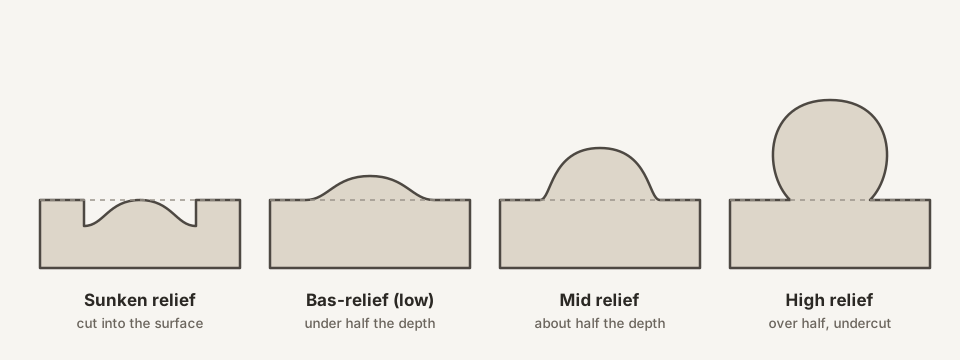
- Bas-relief (low relief): the forms project less than half of their depth and there is no undercutting. Coins, medals and most carved friezes are low relief.
- Mid relief (mezzo-rilievo): about half of the form projects. It is the in-between case, and many panels drift into it in places.
- High relief (haut-relief, alto-rilievo): more than half of the form projects. Heads, arms and legs are often undercut and can detach from the background completely. The Gigantomachy frieze of the Pergamon Altar is a famous example; our guide to high relief covers it in depth.
- Sunken relief: the image is cut into the surface instead of standing out from it, so its highest points are level with the surrounding stone. It is the signature of ancient Egyptian temple walls, where hard sunlight makes the carved outlines razor sharp.
- Flattened relief (rilievo schiacciato): an extremely shallow relief, sometimes only a few millimetres deep, that Donatello developed in fifteenth-century Florence to suggest deep space with almost no real depth.
Sculptors mix the types freely. A single panel may put the foreground figures in high relief and let the background fade into bas-relief, which is one of the oldest tricks for suggesting distance.
Famous bas-relief examples through history
Low relief is one of the oldest ways of making pictures that last, and the best-known examples span most of recorded history.
- Ancient Egypt. The walls of temples and tombs were covered in low and sunken relief, originally painted. The carving recorded offerings, battles and daily life in a format that has survived for thousands of years.
- Assyria. The palaces at Nimrud and Nineveh were lined with slabs of gypsum alabaster carved in low relief. The lion-hunt reliefs of King Ashurbanipal, made around 645–635 BC and now in the British Museum, are among the most admired animal sculptures ever made.
- Persia. At Persepolis, the stairways of the Apadana show delegations from across the Achaemenid empire bringing tribute, carved in crisp limestone bas-relief in the late sixth and early fifth centuries BC.
- Greece. The Parthenon frieze, carved around 443–438 BC, ran about 160 metres around the temple in low relief. It is usually read as the procession of the Panathenaic festival.
- Rome. Trajan's Column, dedicated in AD 113, winds a continuous bas-relief frieze roughly 190 metres long around its shaft, telling the story of the emperor's wars in Dacia.
- Southeast Asia. Borobudur in Java, built in the ninth century, carries 2,672 relief panels. Angkor Wat in Cambodia, from the twelfth century, is famous for its long galleries of narrative bas-reliefs, including the Churning of the Ocean of Milk.
- Renaissance Italy. Lorenzo Ghiberti spent from 1425 to 1452 on the gilded bronze doors of the Florence Baptistery, the "Gates of Paradise", whose ten panels move from high relief in front to the faintest bas-relief in the distance.
- The modern world. Art Deco buildings, war memorials, medals and commemorative plaques all keep the tradition going. So does every coin: a coin die is a bas-relief sculpture in steel.
What is a bas-relief made of?
Almost any material that can be carved, modelled or cast has been used. Four families cover most of what you will meet.
Stone bas-relief
Marble, limestone, sandstone and alabaster are the classic choices. A stone bas-relief is made by subtraction: the sculptor cuts the background away and leaves the image standing. Stone is slow to work and unforgiving, but it lasts, which is why so much architectural sculpture is stone.
Wood bas-relief
Limewood (basswood), oak and walnut carve cleanly and hold fine detail. A wood bas-relief is cut with gouges and chisels in much the same order as stone, but faster and at a smaller scale. You find it on doors, furniture, church panels and a great deal of folk art.
Bronze and brass bas-relief
Metal reliefs are made in two ways. Bronze plaques, doors and medals are cast from a model made in clay or wax. Brass and copper panels are often worked from thin sheet instead, by repoussé (hammering the design out from the back) and chasing (refining it from the front). A hammered brass bas-relief is a staple of decorative wall art.
Plaster and clay bas-relief
Here the method is additive. Clay is built up on a flat board, then either fired as terracotta or used to make a mould for casts in plaster, concrete or resin. Plaster bas-relief wall art has had a real revival: artists build the design directly on a canvas or a wall with plaster or joint compound and leave it white, so the shadows do all the work.
Modern makers add a fifth family: resin casts, CNC-milled wood and 3D-printed plastic, all of which start from a digital model.
How to make a bas-relief
There are three routes, and they suit different amounts of time and skill.
1. Carve it
- Draw the design on the panel or block.
- Lower the background around the outline to the depth you want. Carvers call this grounding.
- Find the highest points of the subject and work down from them, rounding each form into its neighbours.
- Compress the depth as you go. Keep overlaps and edges clear, because they tell the eye what is in front.
- Refine the surface, then check it under a light from the side.
2. Model it
Roll out a slab of clay, sketch the design, then add clay where the form rises and press it back where it falls. Keep everything attached to the background and avoid undercuts if you plan to make a mould. Once the clay model is finished you can fire it or cast it.
3. Generate it from a photo
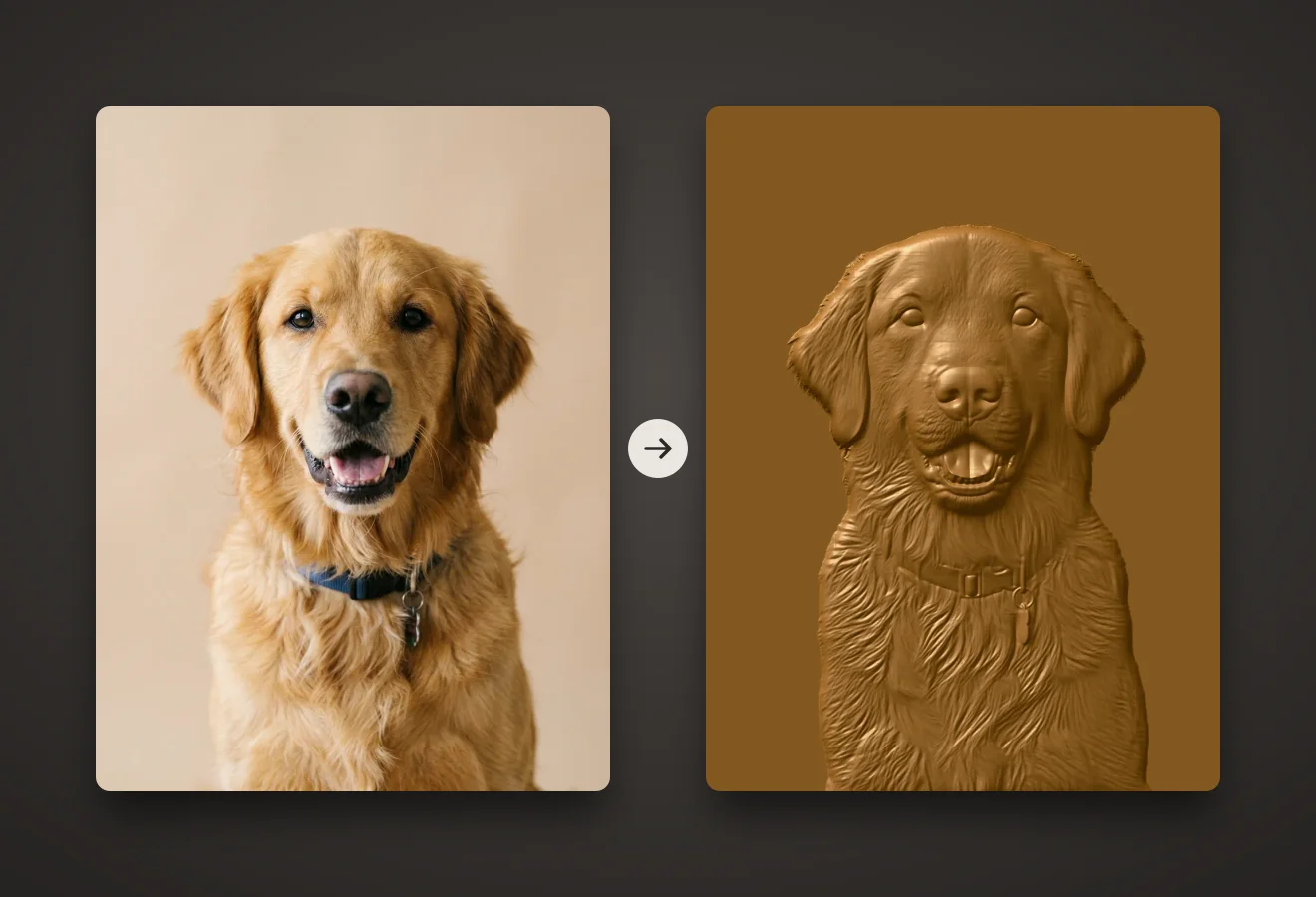
Seen as data, a relief is a height map: every point on the surface has a height. That means software can build one from a picture. Our image to relief generator reads a photo, estimates its depth, turns that depth into height, and shows the result as a 3D model that you can rotate and adjust. You then download an STL or OBJ file and 3D print it, mill it on a CNC router, or print a mould and cast it in plaster.
A few tips carry over from the traditional craft:
- Choose a subject with a clear outline. A profile portrait, a pet's head or a single flower works better than a crowded scene.
- Keep it shallow. Two to five millimetres of relief on a 100 mm plaque is plenty. Too much depth turns a bas-relief into a distorted statue.
- Smooth before you sharpen. A soft, continuous surface with a few crisp edges reads better than a noisy one.
- Judge it under side light. Rotate the 3D preview, or hold the print near a window, before you decide it is finished.
If you plan to print the result, our relief to 3D guide lists the layer height, infill and orientation that give the cleanest surface.
Why bas-relief still matters
A bas-relief sits between a picture and a statue, and it keeps the best of both. It is as easy to hang and to read as a painting, but it is physical: it catches light, it can be touched, and it survives weather that would destroy paint. That is why it has been the default format for coins, monuments and memorials for five thousand years, and why it is now used for tactile images that blind and low-vision readers can explore by hand.
What has changed is who can make one. Carving stone takes years to learn. A height map, a 3D printer and an afternoon are enough to turn a favourite photo into a plaque you can hold.
Quick answers
How do you pronounce bas-relief? "Bah ruh-LEEF". The s is silent, as in French.
What is the difference between a relief and a bas-relief? Relief is the general term for sculpture attached to a background. Bas-relief is the low kind, where the forms project only slightly.
Is a coin a bas-relief? Yes. The portrait and lettering on a coin are a textbook low relief, usually well under a millimetre deep.
What is the opposite of a bas-relief? High relief, where the forms project strongly and may be undercut. In another sense the opposite is sunken relief, where the image is carved into the surface instead of rising from it.